
Blog
SEO + GEO: The Best Strategy for 2026
Search is no longer just a box where people type a few words and receive a list of websites.
In 2026, people are asking longer questions, expecting more direct answers, and increasingly interacting with AI-powered search experiences. This change is creating a new challenge for businesses: how can a website remain visible when search itself is becoming more intelligent?
For many years, the answer was SEO.
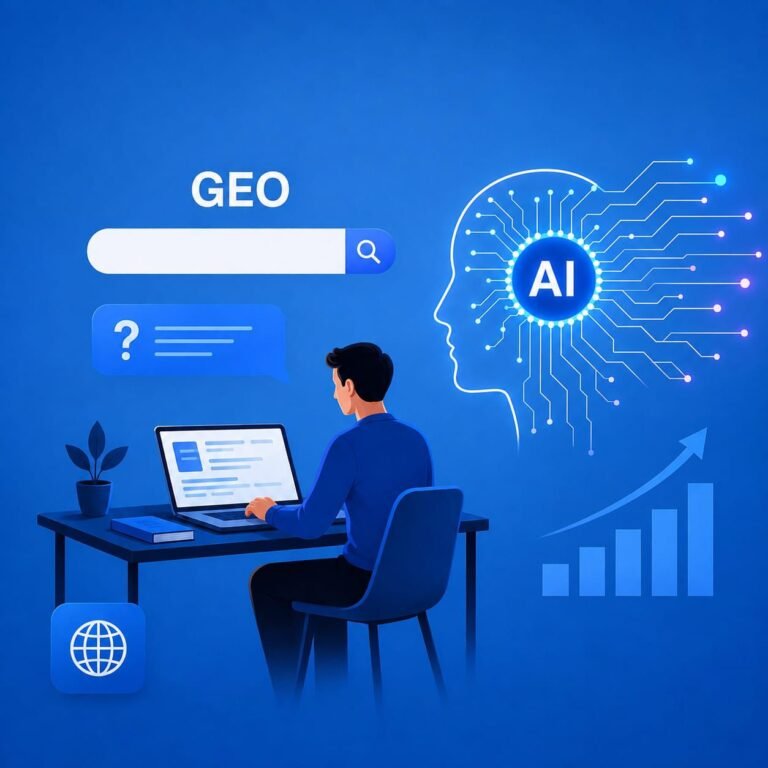
Now another concept is attracting attention: GEO, or Generative Engine Optimization.
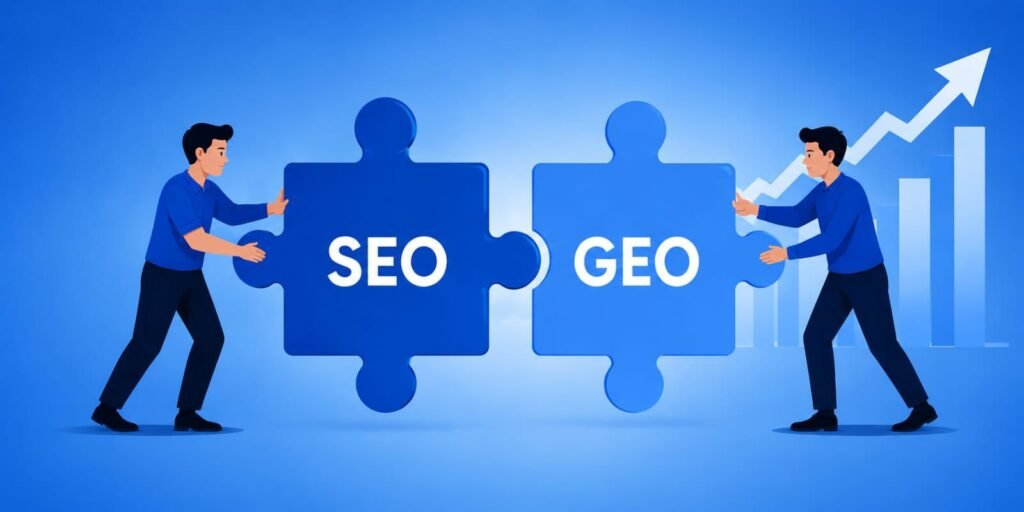
Some marketers treat SEO and GEO as competing strategies. That approach misses the bigger picture. A better way to look at them is as two parts of a modern search strategy.
SEO helps build the foundation. GEO encourages businesses to think about visibility in AI-generated search experiences.
Together, they create a practical approach for digital marketing in 2026.
Search Has Changed, but the Goal Hasn't
Suppose you want to learn how to promote a small business online. You might search for “small business digital marketing tips” and open several articles.
Now imagine asking an AI-powered search experience:
“I run a small clothing business with a limited budget. What digital marketing activities should I start with?”
The second question is more detailed and expects a useful explanation rather than simply a collection of links.
Google has said that its AI search experiences are designed around helping people find useful information, and its guidance continues to emphasize unique, satisfying content.
This means businesses need to think beyond keywords.
They need to think about questions, problems, context, and useful answers.
SEO Still Gives You the Foundation
SEO has not suddenly become outdated.
A website still needs to be technically accessible. Search systems need to be able to discover and process its pages. Visitors still expect a website to load properly and provide information that matches what they are looking for.
That is why basic SEO remains important.
A healthy SEO strategy can involve:
- Understanding search intent
- Choosing relevant topics
- Creating useful pages
- Improving website structure
- Connecting related articles
- Making important pages accessible to search engines
- Improving the overall user experience
- Keeping information accurate
Google’s 2026 guidance for generative AI search specifically says that established SEO best practices remain relevant.
So, if someone tells you that GEO has completely replaced SEO, be careful.
It hasn’t.
GEO Adds a New Question
SEO mainly asks:
“How can people discover this page through search?”
GEO adds another question:
“How can this information be useful when an AI system is helping someone find an answer?”
Consider a travel website.
A basic article might say:
“10 Places to Visit in Kerala.”
That’s useful, but it is also a topic covered by countless websites.
A more distinctive article might be:
“A Three-Day Kerala Trip for First-Time Visitors Who Don’t Want to Spend Hours Travelling Between Destinations.”
The second topic has a clear audience, a specific problem, and a defined situation.
That difference matters.
AI-powered search is particularly useful for longer and more specific questions. Google has highlighted the importance of unique, valuable content for these AI experiences.
Don't Create Content Just Because a Keyword Is Popular
This is one of the easiest mistakes to make.
Imagine you discover that “digital marketing trends 2026” is a popular keyword.
You could immediately write an article by collecting information from ten other websites and rearranging their points.
Technically, you have produced an article.
But what new value does it provide?
If the answer is “not much,” the article is unlikely to stand out.
Google’s people-first guidance asks creators to consider whether their content provides original information, research, analysis, or substantial additional value rather than simply copying or rewriting other sources.
This gives us a useful rule for SEO + GEO:
Don’t ask only, “What keyword should I target?”
Also ask:
“What can I explain better, differently, or more usefully?”
Originality Becomes a Competitive Advantage
AI can help produce text very quickly.
That sounds like an advantage until every competitor can do the same thing.
If ten websites publish nearly identical articles about the same topic, producing the eleventh generic article doesn’t give you much of an advantage.
Original information does.
For example, a digital marketing student could create an article based on:
- A personal learning experience
- A small experiment
- A campaign analysis
- A comparison of tools
- An interview
- A survey
- A practical case study
These elements give an article something that generic content cannot easily provide.
You don’t necessarily need a huge company or expensive research budget.
Even a small observation can make content more distinctive when it is relevant and honestly explained.

Build Articles Around Problems, Not Just Keywords
A useful way to combine SEO and GEO is to begin with a problem.
Let’s say your target audience is beginner digital marketers.
Instead of creating ten disconnected keyword-based articles, you could build content around their actual journey:
Problem: “I don’t know where to start.”
Create a beginner’s digital marketing guide.
Problem: “I don’t know what to post.”
Create an Instagram content guide.
Problem: “My website gets no visitors.”
Create an SEO troubleshooting guide.
Problem: “AI is changing search. What should I learn?”
Create an SEO + GEO guide.
Now your website isn’t just a collection of articles.
It becomes a resource that helps someone move from one problem to the next.
Make Your Content Easy to Understand
Being original doesn’t mean making your writing complicated.
In fact, clear writing is often more useful.
Use meaningful headings. Break large sections into smaller pieces. Give examples when an idea is difficult. Explain technical terms instead of assuming that everyone understands them.
For example, instead of writing:
“GEO improves generative search visibility.”
You could explain:
“GEO is about creating information that is clear, useful, and credible enough to potentially be considered when an AI-powered search system prepares an answer.”
The second version takes slightly longer but gives a beginner a much better understanding.
Don't Ignore the Technical Side
Great content cannot do everything by itself.
Your website still needs a solid technical foundation.
Important areas include:
- Crawlability
- Indexability
- Mobile usability
- Page performance
- Clear navigation
- Internal links
- Descriptive page titles
- Useful metadata
- Accessible content
Google’s guidance for AI search says websites need to meet the technical requirements that allow Google to find, crawl, and index their content.
So the SEO part of the strategy should not disappear simply because the content is designed with AI search in mind.
Use AI as a Tool, Not as Your Source of Originality
AI can be extremely useful during content creation.
It can help with:
- Brainstorming ideas
- Creating outlines
- Finding questions to investigate
- Improving readability
- Identifying gaps in an article
- Generating variations of headlines
But there is a difference between using AI to assist your thinking and publishing generic AI-generated material without adding anything of your own.
Google’s guidance focuses on the quality and usefulness of the final content rather than simply whether AI was involved in its production. It also warns against using automation primarily to manipulate search rankings.
The safest approach is simple:
Use AI to speed up the work. Use human judgment to create the value.
A Practical SEO + GEO Workflow for 2026
If you’re creating a new article, try this process:
Step 1: Choose a real audience problem
Start with something people genuinely need help solving.
Step 2: Research the search language
Find the words and questions people use when looking for that solution.
Step 3: Add something original
Include an example, experiment, comparison, experience, observation, or analysis that isn’t just copied from another website.
Step 4: Organize the information clearly
Use headings and sections that follow the reader’s natural questions.
Step 5: Optimize the technical basics
Make sure the page is accessible, readable, fast, and properly structured.
Step 6: Review it as a reader
Ask yourself:
“If I found this article today, would it actually solve my problem?”
If the answer is no, improve it before publishing.
What Does Success Look Like?
Success shouldn’t be defined only by ranking number one.
A useful article might bring:
- Organic visitors
- Brand awareness
- Email subscribers
- Enquiries
- Customers
- Returning readers
- References from other websites
Google has also introduced Search Console reporting for visibility from generative AI features, including AI Overviews and AI Mode, although the reports are being rolled out gradually.
This shows that AI search visibility is becoming something website owners can increasingly monitor rather than simply speculate about.
The Real Meaning of SEO + GEO
SEO + GEO isn’t about discovering a secret formula.
It is about adapting your content strategy to the way search is developing.
SEO reminds you to make your website discoverable and technically sound.
GEO encourages you to think about whether your information is useful in an AI-assisted search environment.
But neither strategy can replace the most important ingredient:
content that deserves attention.
If your article contains nothing original, adding more keywords won’t suddenly make it valuable.
If your website is technically difficult to access, a brilliant article may still struggle to reach readers.
And if your content genuinely solves a problem, explains something clearly, and gives readers a reason to trust it, you have created something much stronger than a page designed only to chase rankings.
Conclusion
The search landscape of 2026 is different from the one businesses knew a few years ago.
AI-powered search is changing how people ask questions and discover information. But the fundamentals haven’t disappeared.
Businesses still need websites that search systems can access. They still need useful information. They still need to understand their audience.
The difference is that today’s content strategy needs to consider more than traditional rankings.
That is why SEO + GEO makes sense.
Use SEO to build a strong foundation.
Use GEO thinking to understand the changing search environment.
And use original ideas, useful information, and genuine expertise to give people a reason to choose your content.
The goal isn’t to create more content than everyone else.
The goal is to create content that has something worth finding.